Non-Sparking Tools for LPG Bottling Plants & Transport Trucks
- May 26, 2025
- 6 min read
Updated: 6 days ago
LPG bottling plants are critical facilities in the downstream petroleum distribution network. These plants receive bulk Liquefied Petroleum Gas from refineries and storage terminals and fill it into cylinders for domestic, commercial, and industrial use. The filling process typically takes place on automated cylinder carousels where empty cylinders are inspected, filled, weighed, sealed, and prepared for dispatch.

Apart from cylinder filling, LPG bottling plants also load bulk LPG into tank trucks that transport gas to satellite storage locations and industrial consumers. During these operations, LPG loading lines and vapor return lines are connected to bulk tank trucks through threaded coupling nuts. These couplings must be tightened and loosened repeatedly throughout the day as trucks arrive and depart from the loading gantry.
The coupling and decoupling of these lines is a continuous activity. Any improper connection can lead to leakage of LPG vapors, which creates a high-risk environment for fire or explosion. For this reason, the selection of correct non sparking tools becomes an important engineering control during these operations.
To understand the broader role of ignition control in hazardous environments, readers may also refer to the Ultimate Guide to Non Sparking Tools, which explains the fundamentals of spark prevention in industrial safety.
Safety Considerations When Handling Liquefied Petroleum Gas (LPG)
Liquefied Petroleum Gas is a highly flammable hydrocarbon stored under pressure. Even a small release of LPG can quickly vaporize and form a combustible gas cloud. When mixed with air in the right concentration, this vapor cloud becomes highly explosive.
In LPG bottling plants and loading gantries, two elements of the fire triangle are always present — fuel and oxygen. The only controllable factor is the ignition source. Mechanical sparks produced by conventional steel tools can provide sufficient energy to ignite LPG vapors.
When steel tools strike metal surfaces, slip on fasteners, or fall on concrete floors, they may produce incandescent sparks. In a vapor-rich environment, this spark can immediately ignite the gas cloud. For this reason, certified non sparking hand tools, spark resistant tools, or spark-free tools are mandatory in LPG installations.
he same principle applies across other petroleum installations such as oil depots and terminals, refinery maintenance areas, and pipeline facilities. In all these locations, ignition source control is achieved by replacing steel tools with approved non spark tools manufactured from specialized alloys.
Case Study: Pipe Wrench Usage at an LPG Tank Truck Loading Bay

At many LPG bottling plants, tank trucks position themselves under the loading gantry where LPG liquid and vapor lines are connected through large threaded couplings. The connection and disconnection of these couplings is carried out several times a day as trucks arrive for filling.
The safety of this operation depends heavily on the correct tightening of the coupling nut. If the nut is not properly engaged, LPG may leak during loading, creating a potentially explosive atmosphere around the gantry area.
A common operational challenge faced by plant operators is the availability of the correct tool for tightening and loosening these couplings. In many installations, operators resort to using conventional steel pipe wrenches to perform this task.
This practice introduces several safety and operational problems.

Steel pipe wrenches can produce sparks when they slip or strike steel surfaces. In a loading bay where LPG vapors may be present, even a small spark can lead to a catastrophic fire or explosion.
Another challenge arises from the size mismatch between the tool and the coupling nut. A typical 36-inch pipe wrench has a maximum jaw opening of around 82 mm. However, many LPG coupling nuts used in loading gantries measure approximately 85 mm. This prevents proper engagement between the tool and the nut.
Because of this mismatch, operators often apply uneven torque or excessive force during tightening. The hardened steel jaws of the pipe wrench also damage the softer brass coupling nuts, leading to premature wear and frequent maintenance.
These challenges highlight the importance of using purpose-built non sparking safety tools designed specifically for LPG loading operations.
To address this issue, specialized Non-Sparking Open Valve Wrenches manufactured from Copper Titanium or Aluminium Bronze alloys are used. These tools are engineered to match the exact dimensions of LPG coupling nuts and provide a secure grip without damaging the equipment. Such sparkless tools eliminate ignition risks while allowing operators to apply controlled torque during coupling and decoupling of LPG loading lines.
OISD Standards for LPG Bottling Plants
LPG bottling plants in India operate under strict safety regulations issued by the Oil Industry Safety Directorate (OISD). These guidelines define the equipment, procedures, and safety practices required in petroleum installations.
OISD-STD-118 specifies that only approved non sparking tools should be used in loading gantries and other hazardous areas where flammable vapors may be present. This requirement ensures that maintenance and operational activities do not introduce ignition sources.
OISD-RP-158 recommends the use of spark resistant tools for hose connection and disconnection activities. Since these operations involve frequent tightening and loosening of couplings under potentially hazardous conditions, the correct tools play an important role in preventing accidents.
OISD-144 mandates the exclusive use of non sparking tools in LPG installations. This standard recognizes that steel tools pose a direct ignition risk when used around flammable gases such as LPG.
Compliance with these standards is routinely verified during safety audits conducted by regulators and internal safety teams. The use of certified non sparking tools therefore becomes a critical element of regulatory compliance and operational safety.
Many documented industrial incidents have occurred due to the use of conventional steel tools in flammable environments. Several case studies describing such accidents are discussed in detail in our article on fire incidents caused by steel tools in hazardous areas.
Non Sparking Tools for LPG Bottling and Tank Truck Loading Areas
Non Sparking Open Valve Wrenches

Non Sparking Open Valve Wrenches are specifically designed for coupling and decoupling LPG loading and vapor return lines in tank truck loading bays. These tools provide accurate engagement with the coupling nuts used on LPG loading manifolds.
Unlike pipe wrenches, open valve wrenches use a fixed jaw design that ensures proper grip and uniform torque distribution. This prevents slippage and reduces the risk of damage to brass coupling nuts.
These spark resistant tools are typically manufactured from high-performance alloys such as Copper Titanium or Aluminium Bronze. Both materials suppress spark formation while maintaining sufficient mechanical strength for industrial operations.
The ergonomic construction and knurled handles improve operator grip even in oily or dusty environments. This is particularly useful in loading gantries where tools are used repeatedly throughout the day.
Non Sparking Spanners and Wrenches
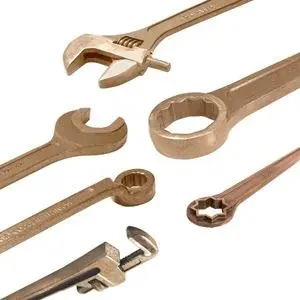
Standard spanners and wrenches are widely used in LPG bottling plants for tightening flange bolts, servicing pump assemblies, and maintaining filling equipment. These tools must be manufactured from approved non-ferrous alloys to prevent spark generation.
Non sparking spanners are designed with precise dimensional tolerances to ensure proper engagement with fasteners. Accurate fit reduces the risk of slipping and ensures efficient torque transmission.
Non Sparking Hammers and Mallets

Non Sparking Hammers and Mallets are used for controlled impact applications such as alignment, equipment adjustment, and removal of seized components. These tools are designed to deliver mechanical force without producing friction sparks.
The heads of these hammers are manufactured from specialized non-ferrous alloys that suppress spark formation when striking metal surfaces. This makes them suitable for use in LPG bottling plants, loading gantries, and maintenance workshops located within hazardous zones.
Spark proof hammers also help prevent damage to delicate equipment components, as the softer alloy material reduces the risk of surface deformation compared to hardened steel tools.
LPG bottling plants and tank truck loading operations involve continuous handling of highly flammable gases. Since fuel and oxygen are always present in such environments, controlling ignition sources becomes the most effective way to prevent fires and explosions.
The use of certified non sparking tools, spark resistant tools, and spark-free tools plays a vital role in maintaining safety during coupling operations, equipment maintenance, and emergency interventions.
Specialized alloys such as Copper Titanium and Aluminium Bronze ensure that these tools provide both mechanical reliability and spark suppression. When used correctly, they help organizations comply with regulatory standards such as OISD guidelines and IS 4595 certification requirements.
If you are evaluating safety improvements for LPG installations, you may download our complete catalogue of certified BronAL Aluminium Bronze and QTi Copper Titanium non sparking tools, or send an RFQ to discuss specific operational requirements with our engineering team.


Comments