Non-Sparking Tools for Oil Depot & Terminals, Railway Sidings & AFS
Updated: Feb 26

Oil depots, petroleum terminals, railway sidings, and Aviation Fuel Stations (AFS) form the final stage of the downstream petroleum supply chain. At these facilities, Motor Spirit (MS) and High-Speed Diesel (HSD) are received through pipelines or railway tank wagons and transferred into road tankers for retail distribution.
These operations involve continuous handling of large volumes of Class A and Class B petroleum products. Flammable vapors are frequently present around unloading bays, manifolds, and storage areas. In such environments, ignition control is a critical element of operational safety.
For this reason, non sparking tools are essential safety equipment. Certified spark resistant and spark proof tools help eliminate mechanical ignition sources during maintenance and transfer operations.
Common Operations and Challenges at Depots, Terminals, and AFS
India operates more than 320 petroleum depots and terminals connected to refineries, pipelines, and the national railway network. A significant portion of fuel movement to these facilities takes place through railway tank wagons.
A standard rake typically consists of 48 to 50 wagons, each carrying approximately 65 to 80 kiloliters of Motor Spirit or High-Speed Diesel. These wagons are positioned at railway sidings and connected to the terminal’s product pipeline system for controlled unloading.
Operations teams are responsible for coordinating rake placement, valve operations, hose connections, product transfer, and isolation procedures. Safety managers ensure that all activities are executed in accordance with approved SOPs, OISD guidelines, and PESO regulations.
Speed vs Safety: Impact of Demurrage Charges
Railway unloading operations are governed by strict time limits. In most cases, rakes must be unloaded within 7 to 9 hours to avoid demurrage charges imposed by Indian Railways.
As per prevailing norms, demurrage charges may reach ₹150 per wagon per hour. For a full rake, this can translate into losses exceeding ₹7,000 per hour. Repeated delays across multiple locations can significantly impact operational budgets.
Due to this financial pressure, operations teams are often required to increase unloading speed. When safety systems are weak or resources are inadequate, shortcuts may be taken. Improper tool selection and unsafe work practices are usually among the first areas where risk increases.
Jugaad Tools and Improper Use of Non Sparking Tools
Railway tank wagons frequently arrive in suboptimal mechanical condition. Valve assemblies may be poorly maintained, damaged, or partially functional.
Common challenges include missing master valve wheels, seized valve stems, worn square heads, damaged gaskets, corroded fasteners, and restricted working space beneath wagons. These conditions often require high torque for valve operation.

In many cases, standard hand tools are inadequate for such demanding conditions.
As a result, operators fabricate steel extensions or improvised “jugaad” tools using pipes and plates to generate additional leverage.
While these tools may help complete operations quickly, they introduce severe ignition hazards. Steel-to-metal contact, tool slippage, and impact can easily generate sparks in vapor-rich environments. Continued reliance on such practices significantly increases accident probability and must be eliminated.
Non-Compliance with OISD and PESO Standards
Depot and terminal operations are regulated by frameworks issued by the Oil Industry Safety Directorate (OISD) and the Petroleum and Explosives Safety Organization (PESO). These authorities emphasize fire prevention, ignition source control, emergency preparedness, and safe operating procedures.
The use of uncertified steel tools or improvised equipment in hazardous zones directly violates these regulatory requirements. Such non-compliance can lead to adverse audit observations, financial penalties, suspension of operations, and increased regulatory and insurance scrutiny.
Certified non sparking tools form a critical component of regulatory compliance and safety assurance. Their proper use demonstrates due diligence, strengthens safety management systems, and helps organizations maintain uninterrupted, legally compliant, and incident-free operations.
Case Study: Major Fire at Tank Wagon Railway Siding
In 2015, a major fire occurred at a petroleum depot railway siding during unloading operations, resulting in the loss of approximately 100 KL of petroleum products. During unloading, a flange joint developed leakage, and instead of isolating the wagon, operators attempted corrective tightening under live operating conditions.
While tightening the joint, a steel spanner slipped and generated a spark. The accumulated fuel vapor cloud ignited immediately, leading to a flash fire that rapidly spread across the wagon and unloading area. The investigation concluded that proper valve isolation and the use of certified non sparking tools would have prevented the incident.

This case represents only one of many similar incidents reported across the oil, gas, and chemical sectors. Numerous documented accidents have occurred due to the continued use of steel tools and improvised “jugaad” tools in flammable environments.
We have compiled additional internationally published case studies where improper tool selection directly led to fires, explosions, and serious injuries. These recurring incidents clearly demonstrate that eliminating steel tools and adopting certified non sparking tools is a fundamental requirement for preventing industrial fire hazards.
Non Sparking Tools for Depot & Terminal, Railway Sidings and AFS
Pahwa MetalTech has developed specialized non sparking tools for railway siding, terminal, and AFS operations to address the practical challenges faced during fuel handling and unloading activities. These tools have been engineered in close collaboration with depot managers and safety managers, ensuring they meet real-world operational, safety, and ergonomic requirements.
By working directly with end users, Pahwa MetalTech has optimized these tools to improve unloading efficiency while maintaining strict ignition control. The following range of tools supports safe and reliable railway siding, truck filling, and aviation fuel handling operations without compromising operational speed.
These non sparking tools are manufactured in compliance with applicable regulatory requirements. As per OISD-STD-117, petroleum installations are required to maintain certified non sparking emergency tool kits. In addition, PESO inspections routinely verify the availability, certification, and condition of non sparking tools during safety audits. Our products are designed to meet these compliance expectations and support long-term regulatory adherence.
Non Sparking Master Valve (Top Valve) Wrench

The Non Sparking Master Valve Wrench is used to operate the main discharge valve located at the top of railway tank wagons. Ideally, these wagons should be fitted with hand wheels for manual operation, but in practice, nearly 80% of wagons arrive with missing or damaged wheels. This makes direct valve operation difficult and unsafe.

The master valve wrench is designed to positively engage with the square valve stem, ensuring firm contact and minimizing slippage.
Its extended length provides sufficient leverage to open seized or corroded valves without the need for steel extensions. The T-handle configuration improves grip and operator control. The ergonomic design reduces physical strain during high-torque operations.
Non Sparking F-Keys and Valve Keys

Non Sparking F-Keys and valve keys are used when the master valve wheel is present but difficult to operate manually. Due to the cylindrical shape of tank wagons, operators are often required to stand on curved surfaces and bend forward, which increases fall and injury risk.

F-Keys provide extended reach and controlled leverage, allowing operators to
rotate valve wheels from a safer working position. Their design improves balance and stability during operation. The tools reduce dependence on unsafe body positioning and excessive force. Non-ferrous material prevents friction sparks in vapor-rich environments. They support safe, controlled, and compliant valve handling.
Non Sparking Bottom Valve Wrench (BVW)

Non Sparking Bottom Valve Wrench is used to operate the discharge valve located beneath the tank wagon. This area is typically congested with structural members, hoses, and piping, limiting tool movement and access.
The BVW features an octagonal star-shaped profile that allows 45-degree indexing. This enables gradual valve rotation in confined spaces. With an approximate length of 800 mm, the tool provides high mechanical advantage with minimal operator effort.

It is designed to handle heavily seized valves exposed to dust, moisture, and corrosion. The balanced structure improves handling under low-clearance conditions. Certified non-ferrous material ensures safe use in flammable atmospheres. The BVW is critical for controlled bottom discharge operations.
Non Sparking Star Valve Wrench (SVW)

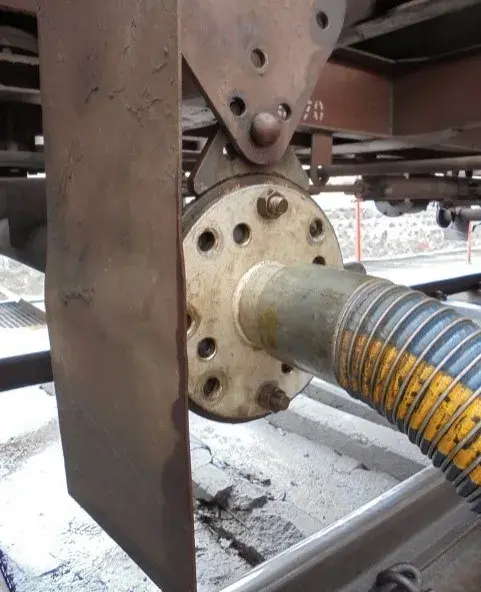
The Star Valve Wrench is used to operate siding and manifold valves connected to the wagon through unloading hoses. These valves regulate fuel flow from multiple wagons into the central pipeline system.
SVWs are similar in design to Bottom Valve Wrenches but are smaller and lighter to match manifold valve dimensions. The

most commonly used size is around 39 mm, though multiple sizes are available to suit different installations. The compact design allows easy handling in narrow valve pits and galleries. Ergonomic grips enhance stability during operation. The tool minimizes slippage and uneven torque application. Certified spark-resistant materials ensure ignition control. SVWs are essential for safe product flow management.
Non Sparking Spanners and Wrenches
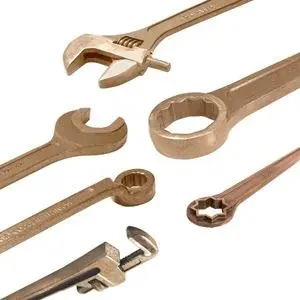
Non Sparking spanners and wrenches are used for tightening and loosening flange bolts, hose couplings, and manifold connections. Commonly used sizes at depots include 18×19 mm and 26×27 mm.
These tools are required for routine maintenance, leak control, and emergency interventions. They are manufactured from approved non-ferrous alloys to prevent impact and friction sparks. Proper
dimensional accuracy ensures secure fastener engagement. This reduces rounding, slippage, and excessive force application. Certified spanners support both safety and mechanical reliability. Their use is mandatory in hazardous fuel handling zones.
Non Sparking Elliptical Spanners

Non Sparking Elliptical Spanners are customized tools developed by Pahwa MetalTech for operating valves with missing, damaged, or irregular handles.

The elliptical profile provides uniform contact with valve stems, reducing localized stress and deformation. This improves torque transfer and minimizes rounding of valve heads. The design allows controlled operation without external extensions.
Non-ferrous construction ensures spark suppression during use. These tools eliminate dependence on unsafe fabricated devices. They are particularly valuable in challenging field conditions and unavailability to valve handle spares.
OISD 16-Piece Non Sparking Tool Kit

The OISD 16-Piece Non Sparking Tool Kit is a mandatory safety requirement for petroleum installations under OISD-STD-117. It is designed to support emergency response, maintenance, and fire prevention activities.
The kit includes essential spanners, hammers, chisels, punches, and hand tools for hazardous environments. All tools are manufactured from certified non-ferrous alloys and tested for spark resistance. The compact and organized layout enables rapid deployment during emergencies. It supports first-response maintenance and isolation tasks. The kit enhances regulatory compliance and audit readiness. It is a critical component of depot safety infrastructure.
All Pahwa MetalTech non sparking tools are available in high-performance Copper Titanium and Aluminium Bronze alloys, selected for their proven spark suppression, mechanical strength, and corrosion resistance. Each tool is fully tested and certified in accordance with IS 4595 standards to ensure reliable performance in flammable and explosive environments.
Copper Titanium tools are recommended for high-load, high-frequency, and safety-critical operations, while Aluminium Bronze tools provide a cost-effective solution for general maintenance. Both material options meet regulatory and audit requirements for petroleum installations.
To understand material selection, certifications, and application best practices in detail, refer to our Ultimate Guide to Non Sparking Tools.
If you have a specific operational requirement, download our complete product catalogue or send us an RFQ. Our technical team will assist you in selecting the right tools, materials, and configurations for your safety and compliance needs.


Comments