Investment Casting and Lost Wax Casting: The Complete Guide to Process, Materials, and Industrial Applications

Investment casting — also known as lost wax casting — is the precision metal forming process that produces complex, near-net-shape metal components in a single operation, from a range of alloys and in geometries that no other casting or forming process can consistently match for accuracy, surface quality, and design freedom. A multi-port copper bus bar junction that would require four machined components and three brazed joints, a duplex stainless steel valve body with internal passages and compound curved surfaces, a thin-wall aluminium aerospace bracket with integrated flanges at multiple orientations — all are single-piece investment castings.
This guide covers the complete investment casting and lost wax casting specification landscape: what the process is, how it works step by step, the variants and process options, the full range of alloy families available, precision capabilities across tolerances, surface finish, wall thickness, and weight range, how investment casting compares to six alternative manufacturing processes, the nine industrial sectors it serves, quality and certification standards, design guidelines, and how to specify a casting correctly for procurement.
For deeper technical insights, explore our alloy-specific investment casting guides. Learn more about copper and bronze alloys, stainless steel investment castings, and aluminium alloy castings across industrial applications. Each guide covers metallurgy, process considerations, material selection, and performance advantages.
What Is Investment Casting — and Why Is It Also Called Lost Wax Casting?
Investment casting and lost wax casting describe exactly the same manufacturing process. The two terms are fully interchangeable across industry, standards organisations, and technical literature. In North American industrial contexts, 'investment casting' is the standard term. Across Europe, and in artistic, jewellery, and dental contexts, 'lost wax casting' or its French equivalent cire perdue is more widely used. Neither term is technically more precise — they are synonyms for the same process.
The word 'investment' in investment casting derives from the Latin investire — to clothe or surround. During the process, the wax pattern that replicates the finished component is literally 'invested' — surrounded and encased — by a ceramic shell that becomes the casting mould. The phrase 'lost wax' refers to the step in which that wax pattern is melted and expelled from the completed shell, leaving a hollow ceramic cavity: the wax is lost.
For procurement teams and engineers specifying internationally, understanding that both terms refer to the same process avoids specification confusion. A supplier responding to an RFQ for 'investment cast duplex 2205 valve bodies' and a supplier quoting on 'lost wax casting of duplex 2205' are quoting on the same manufacturing route. The choice of terminology by the requoting party does not indicate a process difference.
The Lost Wax Casting Process: Nine Steps from Design to Finished Component
The investment casting process follows nine steps in sequence. The quality of the finished casting is determined by process control at every stage. This section provides an overview of the sequence.
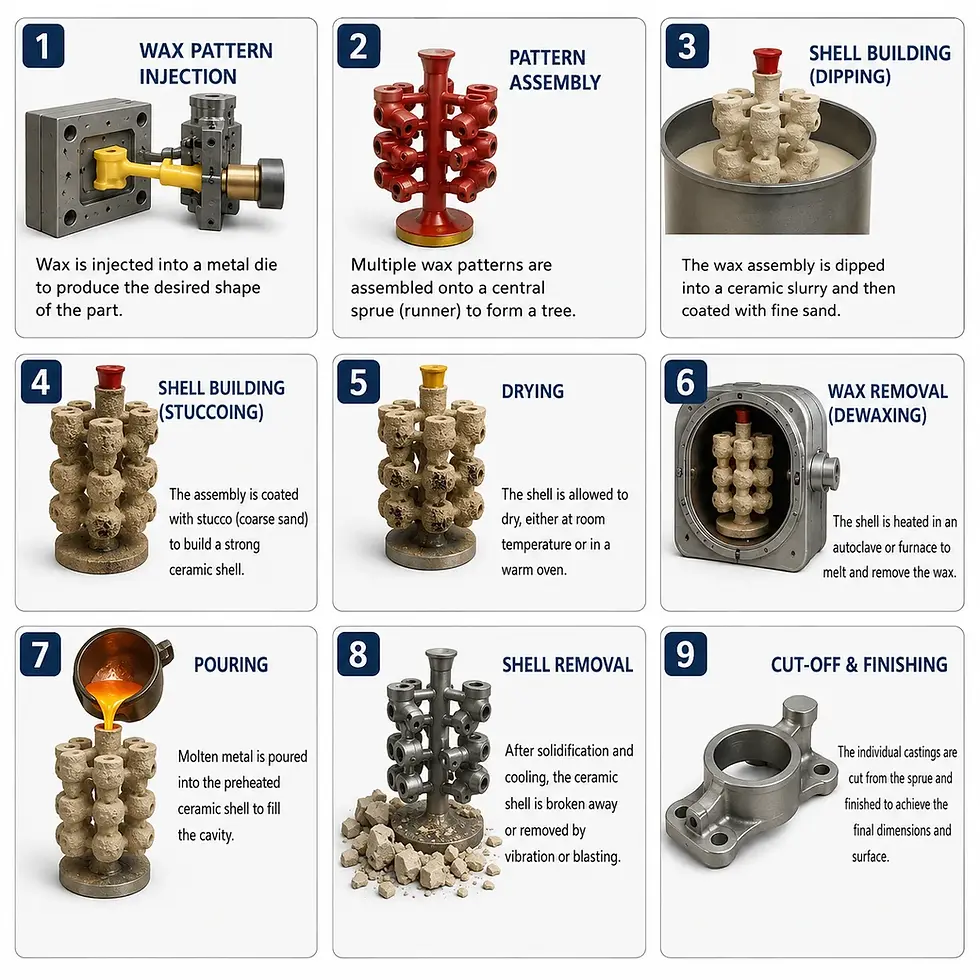
Tooling Design and Die Manufacture : A precision metal die is CNC-machined to the component geometry, incorporating shrinkage allowances for both wax and metal. Die quality is the root of dimensional accuracy in every casting produced from it.
Wax Pattern Injection : Wax compound is injected into the closed die under controlled temperature and pressure. The injected wax replicates the finished component geometry in exact detail. For components with internal passages, ceramic or soluble wax cores are positioned in the die before injection.
Pattern Assembly (Tree Building) : Individual wax patterns are assembled onto a central wax runner system — the tree — that connects all patterns to a sprue. Tree geometry determines fill rate, thermal distribution, and solidification sequence. Solidification simulation is used to optimise the runner design before the first tree is assembled.
Ceramic Shell Building : The wax tree is dipped 8–12 times in ceramic slurry and coated with refractory stucco after each dip, building a 6–10mm shell. Inner fine-grain layers define the as-cast surface finish; outer coarser layers provide structural strength.
Dewaxing: The Lost Wax Step : Autoclave steam at approximately 170°C melts and expels the wax from the ceramic shell, leaving a hollow ceramic cavity. The wax is recovered and recycled. This is the step from which the process takes its popular name.
Shell Firing (Burnout) : The dewaxed shell is fired at 900–1,100°C, removing residual wax traces, sintering the ceramic layers into a structurally integrated mould, and preheating the shell for casting.
Melting and Casting : Molten metal is poured into the preheated shell. Most alloys are air-melted; alloys sensitive to oxygen or nitrogen contamination — OFHC copper, duplex stainless steel, precipitation-hardening grades — are vacuum or inert-atmosphere melted.
Shell Removal and Cutoff : he ceramic shell is removed by vibration, water blasting, and grit blasting. Individual castings are separated from the runner tree and gate stubs are ground flush.
Post-Cast Operations : Heat treatment (mandatory and alloy-specific), shot blasting, post-machining of critical dimensions, surface treatment, and non-destructive testing complete the sequence.
Air Melting and Vacuum Melting Investment Casting — Which Variant Applies?
Investment casting is not a single uniform process — it encompasses a range of variants that differ in melting atmosphere, filling technique, and tooling approach. The relevant variant is determined by the alloy specification and the component geometry.
Air Melting — Standard Investment Casting
Standard route for most alloys. Atmospheric oxygen is managed through alloy chemistry and melt practice. Appropriate for most copper alloys, standard austenitic and martensitic stainless steels, and aluminium alloys.
Vacuum Melting and Controlled-Atmosphere Casting
Required for OFHC copper (oxygen below 10 ppm), duplex stainless (nitrogen retention), and precipitation-hardening stainless grades. Pahwa MetalTech operates both air and vacuum melting in-house.
Material Families Available in Investment Casting and Lost Wax Casting
Investment casting is among the most versatile precision casting processes and is suitable for a broad range of engineering alloy families. Pahwa MetalTech manufactures precision cast components in a wide range of copper alloys, aluminium alloys, and stainless steel alloys for demanding industrial and engineering applications. Detailed alloy families are provided below.
Copper and Copper Alloys — Electrical, Marine, and Industrial
The copper alloy family in investment casting encompasses eight distinct sub-families, each occupying a different position in the conductivity-strength-corrosion landscape:
OFHC Copper C10100 / C10200 — Oxygen below 10 ppm. 101% IACS conductivity. Vacuum interrupters, precision bus bar conductors, components requiring hydrogen-atmosphere brazing without embrittlement risk. For more information see the OFHC vs ETP grade selection guide.
ETP Copper C11000 — 100% IACS conductivity. Standard specification for bus bar junctions, switchgear connectors, terminal blocks, and general high-conductivity electrical hardware.
See our detailed guide on high-performance copper alloy castings in electrical systems: Investment Casting of High Conductivity Copper & Brass Parts for Electrical Switchgear for material selection and process considerations, and Casting vs Fabrication of High Conductivity Bus Bars for a comparative analysis of bus bar manufacturing routes, conductivity performance, and design flexibility.
Copper Chromium Zirconium CuCrZr / C18150 — 80–85% IACS conductivity combined with 400–500 MPa yield strength in the age-hardened condition. Contact tips, current-carrying structural members, high-pressure clamp contacts — applications requiring both properties simultaneously.
Aluminium Bronze C95500 — PREN ~25. Gears, bushings, and wear parts where strength, corrosion resistance, and anti-galling properties are the specification
drivers.
Nickel Aluminium Bronze (NAB) C95800 — PREN ~35 — the highest corrosion resistance of any commonly specified copper alloy. Seawater-immersed propeller hubs, offshore valves, pump impellers, and shaft sleeves. Outperforms SS316L (PREN ~25) in chloride environments.
Tin Bronze C83600 — Self-lubricating bearing surfaces. Plain bearings, bushings, and bearing housings where shaft surface protection under cyclic load is the primary criterion.
Silicon Bronze C87500 — Highest fluidity of the copper alloy family — easiest to investment cast. Architectural hardware, marine fasteners, and decorative components.
Cupronickel 90/10 (C96200) and 70/30 (C96400) — Thermal conductivity combined with seawater corrosion resistance and biofouling inhibition. Marine heat exchangers, condenser tube plates, and seawater cooling system hardware.
Brass CuZn37–CuZn40 and Lead-Free Grades — Valve bodies, terminal fittings, and plumbing hardware. Lead-free NSF 61 / RoHS-compliant brass for potable water contact and EU REACH compliance.
For full copper alloy investment casting guide: Click Here
Stainless Steel — Five Alloy Families for Corrosion-Critical Applications
Stainless steel investment casting spans five fundamentally different alloy families. The selection between them is not a preference but a specification decision driven by corrosion environment, mechanical loading, operating temperature, and regulatory documentation requirements:
Austenitic — SS304 (CF8) / SS316L (CF3M) — The broadest-application stainless family. SS316L for food contact, pharmaceutical, chemical processing, marine auxiliary, and general engineering. SS304 where chloride exposure is limited and molybdenum content is not required.
Duplex — 2205 (CD3MN / 1.4470) — PREN ~35. The standard specification for seawater-service pump and valve bodies, offshore structural components, and chemical process equipment exposed to chloride concentrations that cause pitting in SS316L. The 50:50 austenite : ferrite microstructure also delivers higher yield strength than austenitic grades.
Super Duplex — 2507 (CD3MWCuN / 1.4501) — PREN ~43. Specified when 2205 is borderline — seawater above 25°C, high-chloride chemical environments, and desalination plant components where maximum pitting and crevice corrosion resistance is the primary criterion.
Precipitation Hardening — 17-4 PH (CB7Cu-1) / 15-5 PH — H900 condition: 1,170 MPa UTS, 1,000 MPa yield strength. Aerospace structural castings, defence hardware, high-pressure valves, and components requiring the highest strength of any stainless grade. Age hardening is performed post-cast; the as-cast condition is soft and machinable.
Martensitic — SS410 / SS420 — Through-hardened to 28–35 HRC by quench and temper. Pump impellers in abrasive slurries, cutting tools, surgical instruments, and wear-critical components. SS420 achieves higher hardness than SS410 through higher carbon content.
Ferritic — SS430 / SS446 — High-temperature oxidation resistance. SS446 resists scaling to 1,090°C. Burner components, furnace hardware, and heat exchangers operating above the service temperature limits of austenitic grades.
For dull stainless steel investment casting guide: click here
Aluminium Alloys — Lightweight Precision Castings
Aluminium investment casting serves the aerospace, automotive, and general engineering sectors where low weight, tight dimensional tolerances, and complex geometry are simultaneous requirements. Two grades dominate the application:
A356 (AlSi7Mg0.3) — The standard investment casting aluminium grade. Good fluidity for complex geometry, excellent T6 response (solution treatment + artificial aging), UTS 250–280 MPa in T6 condition. General aerospace, automotive, and industrial structural castings.
A357 (AlSi7Mg0.6) — Titanium-modified A356 with higher magnesium content. T6 UTS of 310–330 MPa — approximately 15% stronger than A356 T6. Specified for aerospace applications under AMS 2357. The higher strength trades against slightly reduced casting fluidity compared to A356.
Precision Capabilities of Investment and Lost Wax Casting — Tolerances, Surface Finish, and Size Range
The precision capabilities of investment casting define its advantage over sand casting, permanent mould casting, and fabrication for complex components. The following represents standard achievable values at Pahwa MetalTech across the alloy families described above. These are working specifications, not marketing claims — they are the basis on which components are quoted and tooled.
Dimensional Tolerances
As-cast dimensional tolerances typically meet ISO 8062 CT5–CT7 grades across copper, stainless steel, and aluminium alloy investment castings. CT5–CT6 applies to standard alloys such as ETP Copper, SS316L, and A356, while CT7 is used for more complex geometries and alloys like Duplex 2205 and CuCrZr. Compared to sand casting (CT10–CT13), investment casting significantly reduces machining requirements, with standard machining allowances of 0.5–2.0 mm versus 2.0–5.0 mm. Critical features such as bores, threads, and sealing faces are finish-machined where tighter tolerances are required.
Surface Finish
As-cast surface finish of Ra 3.2–6.3 µm is standard for investment cast copper, stainless steel, and aluminium components. Compared to sand casting (Ra 10–25 µm), this significantly reduces or eliminates secondary grinding and milling operations. For finer finishes, mechanical polishing achieves Ra 0.8–1.6 µm, while electropolished SS316L can achieve Ra ≤ 0.4 µm for pharmaceutical and nuclear applications. Tumble finishing on copper and bronze castings delivers Ra 0.8–1.2 µm with minimal manual finishing.
Weight Range and Wall Thickness
Parameter | Standard IC | Vacuum-Assisted IC | Notes |
Minimum wall thickness | 1.0–1.5 mm | 0.8 mm | Alloy dependent: copper alloys at lower end, super duplex at upper |
Minimum component weight | 5 grams | 5 grams | Wax pattern handling limits the practical minimum |
Maximum component weight | 70 kg | 70 kg (furnace limited) | Larger components possible with specific project agreements |
Component dimensions | Up to ~800mm | Up to ~600mm | Larger dimensions possible; shell handling constrains upper limit |
Internal passages (cores) | ≥8mm diameter (ceramic core) | ≥8mm | <8mm possible with soluble wax cores; complex 3D passages possible |
Investment Casting vs Six Alternative Manufacturing Processes
Investment casting occupies a specific position in the manufacturing route decision matrix. Each comparison below summarises the key decision criteria. Dedicated guides cover each comparison in full — process economics, decision matrices, and real-world examples.
Investment Casting vs Sand Casting
Sand casting is the natural route for large, simple geometry at low volumes where tooling cost must be minimised. Investment casting wins on dimensional accuracy (CT5–CT7 vs CT10–CT13), surface finish (Ra 3.2–6.3 vs Ra 10–25 µm), minimum wall thickness, and geometric complexity — typically eliminating two to three post-cast machining operations that sand castings require.
Investment Casting vs Die Casting
Die casting delivers excellent surface finish and low per-unit cost at very high volumes, but is restricted to aluminium, zinc, and magnesium. It cannot process copper alloys or stainless steel. Investment casting tooling cost is lower for medium volumes, making it more economical below approximately 10,000–50,000 parts per year even for aluminium.
Investment Casting vs Permanent Mould Casting
Permanent mould casting serves simple aluminium and copper components at medium volumes with better accuracy than sand casting. Investment casting wins on geometric complexity (no draft angles, undercuts achievable), alloy range (full copper and stainless spectrum), and surface finish.
Investment Casting vs Forging
Forging produces superior mechanical properties through grain refinement and work hardening — particularly fatigue strength and impact toughness — but cannot produce complex 3D geometry with undercuts, internal features, or thin walls. Investment casting occupies the geometric complexity space where forging is not feasible and machined properties are adequate for the application.
Investment Casting vs Metal Injection Moulding (MIM)
MIM produces very small, very complex components at very high volumes (>10,000 pieces), but is limited to approximately 100 grams maximum weight, thin uniform sections, and a narrower alloy range than investment casting. Investment casting handles the full copper alloy family (not available in MIM) and components above 100 grams.
Investment Casting vs Additive Manufacturing
Direct metal AM enables one-off geometries and zero-tooling production of prototypes, but has limitations for production volumes: unit cost 5–50× higher than investment casting at medium volumes, as-built surface finish comparable to sand casting (Ra 10–25 µm), and copper alloy processing that remains in development. Investment casting is more economical for production volumes of 10+ pieces per year once tooling is amortised.
Comparison: Investment Casting vs Competing Casting Processes
Parameter | Investment Casting | Sand Casting | Die Casting |
Dimensional tolerance (ISO 8062) | CT5–CT7 | CT10–CT13 | CT4–CT6 |
As-cast surface finish | Ra 3.2–6.3 µm | Ra 10–25 µm | Ra 1–3 µm |
Minimum wall thickness | 0.8–1.5 mm | 3–5 mm | 0.5–1.5 mm (Al/Zn only) |
Draft angles required | None | 1–3° | 3–5° |
Undercuts achievable | Yes | No (core required) | No |
Alloy range | All (copper, SS, Al, and more) | Wide | Aluminium, zinc, magnesium only |
Tooling cost | Medium | Low | High |
Suitable unit volumes | 10 – 100,000+ | 1 – 1,000 | 10,000 – 1,000,000+ |
Industrial Applications of Investment Casting Across Nine Sectors
Investment casting serves a broader range of industrial sectors than any other precision casting process, driven by its alloy flexibility, geometric freedom, and near-net-shape production capability. Each sector below has a dedicated application guide.
Electrical Switchgear and Power Distribution
Multi-port copper bus bar junctions, switchgear connectors, contact arms, and terminal blocks. Investment casting produces complex junction geometry in a single operation without assembly joints — eliminating resistance discontinuities that cause localised heating under high-current loads. ETP copper for standard electrical; OFHC for vacuum interrupters. For more information, follow: Investment Casting of High Conductivity Copper & Brass Parts for Electrical Switchgear
Marine and Offshore
NAB (C95800, PREN ~35) for seawater-immersed propeller hubs, shaft sleeves, and pump impellers. Duplex 2205 and super duplex 2507 for offshore valve bodies and structural fittings. Both alloy families outperform SS316L in full seawater service.
Oil and Gas
SS316L in NACE MR0175 condition for sour service process components. Duplex 2205 for higher-chloride process streams. 17-4 PH for high-pressure wellhead hardware. Copper alloy castings for electrical and instrumentation hardware in Zone 1 and Zone 2 classified areas.
Food Processing and Pharmaceutical
SS316L electropolished to Ra ≤ 0.4 µm for food contact components, valve bodies, vessel internals, and CIP circuit hardware. Compliance with FDA 21 CFR (North America), EC 1935/2004 (Europe), and FSSAI (India). Full material traceability to EN 10204 Type 3.1 standard.
Aerospace and Defence
17-4 PH stainless (H900 condition: 1,170 MPa UTS) for aerospace structural castings and defence hardware. Aluminium A357 (AMS 2357) for lightweight structural castings. Defence applications extend to propellant handling equipment and precision assembly components.
Medical Devices
SS316L and 17-4 PH investment castings for surgical instruments, implant components, and medical device housings. Regulatory compliance — FDA, CE marking — requires full traceability, material certification, and documented first article inspection.
Mining and Minerals Processing
Martensitic SS410/420 for slurry pump impellers and wear-critical components (28–35 HRC through-hardened). Duplex 2205 for structural components in acid mine drainage and high-chloride process water. Investment casting produces near-net-shape wear geometry that minimises machining of hardened surfaces.
Nuclear
SS316L with full material traceability to ASME NQA-1 or RCC-M for auxiliary system and coolant circuit components. EN 10204 Type 3.2 certificates with Authorised Inspection Authority validation. 100% non-destructive testing standard.
General Engineering
Precision investment castings across copper, stainless steel, and aluminium for pumps, valves, instrumentation housings, actuation hardware, and precision mechanical components across all sectors not listed above.
Quality Assurance, Standards, and Certification
Standard | Scope | Applicable For |
ASTM A351 / A743 / A744 | Austenitic and duplex stainless castings | SS316L, SS304 pressure and corrosion-resistant castings |
ASTM A890 / A995 | Duplex and super duplex stainless castings | Duplex 2205 (CD3MN), super duplex 2507 (CD3MWCuN) |
ASTM A747 | Precipitation-hardening stainless castings | 17-4 PH (CB7Cu-1), 15-5 PH aerospace and structural |
ASTM B148 / B584 | Copper alloy castings | All copper and bronze investment cast alloys |
EN 10283 | Corrosion-resistant stainless castings — European | All SS IC for EU procurement |
EN 1982 | Copper alloy castings — European | All copper IC for EU procurement |
EN 10204 Type 3.1 | Inspection certificate — manufacturer validated | Standard for oil and gas, marine, food, pharma procurement |
EN 10204 Type 3.2 | Inspection certificate — third-party validated | Nuclear, offshore, aerospace, critical systems |
ISO 9001:2015 | Quality management system | All Pahwa MetalTech production |
Design Guidelines for Investment Casting and Lost Wax Casting
Investment casting imposes fewer geometric constraints than any other precision casting process. The following are the key design rules.
Design Element | Guideline | Rationale |
Draft angles | None required | The defining geometric freedom advantage over sand casting (1–3°) and die casting (3–5°). |
Minimum wall thickness | 1.0–1.5 mm standard; 0.8 mm vacuum IC | Alloy-dependent. Duplex SS and PH grades: 1.5 mm minimum. OFHC copper and aluminium: 0.8–1.0 mm achievable. |
Internal corners — fillet radius | Minimum 1.5 mm on all internal fillets | Sharp internal corners are stress concentration points and hot-tear initiation sites during solidification. |
Section transitions | 3:1 taper ratio minimum between adjacent sections | Abrupt changes concentrate shrinkage. Taper progressively; avoid steps. |
Internal passages | ≥ 8 mm diameter: ceramic core. < 8 mm: soluble wax core | Core removal access is needed for ceramic cores. Specify core removal windows in the part design. |
Undercuts | Achievable without additional tooling cost | Wax is ejected from the die with flexible mould sections. The shell is destroyed at shakeout. |
Tolerances | CT5–CT7 as-cast; machine critical faces to tighter tolerance | For dimensions tighter than CT5, specify a machining operation. Investment casting cannot hold ±0.05 mm or tighter as-cast. |
Identification | Cast-in part number pad: minimum 15 × 8 mm | Eliminates post-cast stamping. Specify location on a flat or gently curved surface. |
How to Specify an Investment Casting — Procurement Checklist
Correct specification at the procurement stage eliminates the majority of first-article failures and revision cycles. The following eight items are the minimum information required for accurate quoting, tooling, and production.
Item | Requirement | Common Error |
Drawing or 3D model | 2D GD&T drawing or 3D model with tolerances. Both preferred. | 3D model without tolerances — foundry cannot identify critical dimensions. |
Material specification | UNS designation (C11000, C95800) or EN designation (CW004A). Not 'copper alloy' or 'stainless steel'. | Generic alloy — 'stainless steel' interpreted as SS304, SS316L, or SS410. Specify the grade. |
Material certificate | State EN 10204 type: 2.2, 3.1, or 3.2. State if third-party validation required. | Omitting certificate type — foundry supplies 2.2 when 3.1 is required by the purchaser's standards. |
Heat treatment | State condition: T6 (aluminium), H900/H1025 (17-4 PH), solution anneal (duplex 2205). | Not specifying — duplex 2205 supplied as-cast without anneal fails phase ratio and PREN requirements. |
Surface finish | Ra value on drawing with applicable surfaces marked. Electropolishing specified separately. | Specifying Ra without marking surfaces — foundry applies to wrong faces or omits from functional surfaces. |
NDT | Methods and acceptance standards: RT per ASTM E1030, PT per ASTM E165, acceptance level. | Omitting acceptance criteria — foundry does not know what defect size is rejectable. |
Volume | Annual volume estimate and first article quantity. | Not providing volume — tooling amortisation cannot be calculated; quote is on worst-case assumption. |
First article | State if PPAP, FAI, or dimensional report required on first article castings. | Assuming first article inspection is included — it is a chargeable deliverable. |
Pahwa MetalTech — Precision Investment Castings Across All Alloy Families
Pahwa MetalTech produces precision investment castings — also known as lost wax castings — in copper alloys (OFHC, ETP, CuCrZr, aluminium bronze, NAB, tin bronze, silicon bronze, cupronickel, brass), stainless steel (SS316L, SS304, duplex 2205, super duplex 2507, 17-4 PH, martensitic SS410/420, ferritic SS430/446), and aluminium alloys (A356, A357).
Components from 5 grams to 70 kilograms. Air and vacuum melting in-house. Solidification simulation on all new geometries. ISO 9001:2015 certified. Chakan, Pune, India.
To discuss an investment casting requirement — contact us or write to us at info@pahwametaltech.co.in


Comments