Duplex Stainless Steel 2205 Investment Casting: Properties, Process and Applications
TL;DR — Key Takeaways
Duplex 2205 offers approximately twice the yield strength of SS316L (≥415 MPa vs ~200 MPa) with a Pitting Resistance Equivalent Number (PREN) of approximately 35 — compared to PREN ≈ 25 for SS316L cast grade CF8M
Investment cast duplex 2205 is specified as ASTM A890 Grade 4A (ACI designation CD3MN, UNS J92205) — not the wrought designation UNS S32205 used in most generic material references
Solution annealing to a minimum of 1050°C followed by immediate water quenching is mandatory — a duplex 2205 casting that has not been correctly solution annealed will not meet ASTM A890 Grade 4A corrosion resistance or mechanical property requirements.
Minimum wall thickness for duplex 2205 investment castings is 2.0mm — 0.5mm higher than austenitic grades such as SS316L.
Key applications: oil and gas valve bodies and choke valves, marine seawater pumps, chemical processing impellers, desalination plant equipment, and pulp and paper bleach plant components.
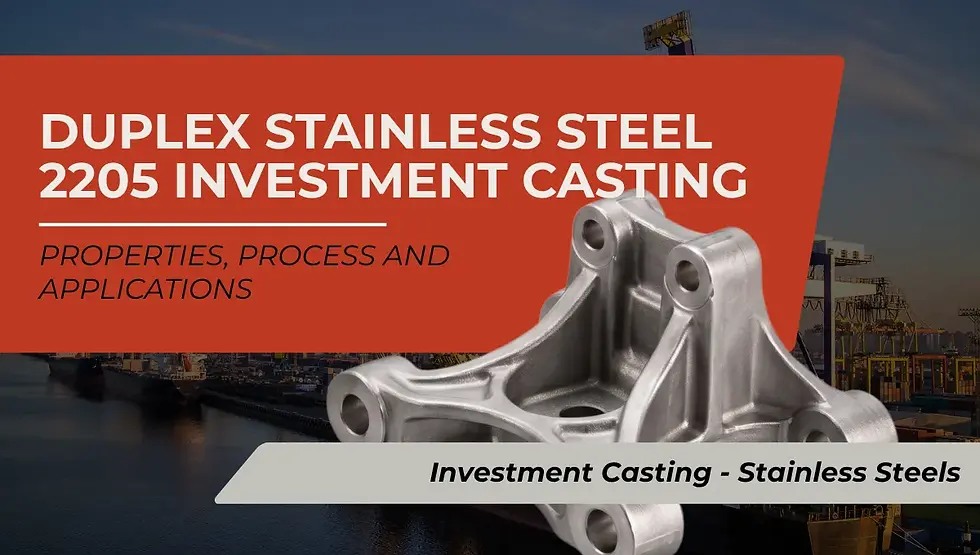
Duplex stainless steel 2205 investment casting — produced by the lost wax casting process — occupies a specific and well-defined position in the materials selection hierarchy for corrosive and high-stress industrial environments: stronger than austenitic stainless steel, more corrosion-resistant than SS316L in chloride-bearing media, and significantly less expensive than nickel-based alloys.
For engineers and procurement teams specifying components for oil and gas, marine, chemical processing, or water treatment applications, understanding the specific properties, casting process requirements, and standards that apply to cast duplex 2205 — as distinct from its wrought counterpart — is the starting point for correct specification.
For a complete understanding of the investment casting process, read Investment Casting: Process, Materials, and Industrial Applications. For detailed coverage of stainless steel investment castings, including alloy selection, precision capabilities, and application-specific requirements, visit Stainless Steel Investment Casting: Alloys, Precision Capabilities, and Industrial Applications.
Why Duplex Stainless Steel 2205 Exists — The Problem It Solves
The selection of duplex 2205 for a cast component almost always begins with the failure of a simpler material in service.
SS304 and SS316L are the workhorses of stainless steel investment casting — economical, well-understood, and adequate for a wide range of applications. Their limitation is chloride environments - SS316L (CF8M in cast form) suffers pitting corrosion in warm seawater, stress corrosion cracking in chloride-bearing process fluids, and crevice corrosion at flanged joints in coastal and offshore service. Components that should last ten years fail in two.
Carbon steel corrodes rapidly without protective coatings, which fail in aggressive media. Nickel-based alloys — Hastelloy, Inconel — offer excellent corrosion resistance but at a material cost typically five to ten times that of duplex stainless steel.
Duplex 2205 was developed to occupy the space between these options. Its dual-phase microstructure delivers yield strength approximately twice that of SS316L, corrosion resistance measurably superior to SS316L in chloride environments, and a material cost that — while higher than austenitic stainless — is a fraction of nickel-based alloys.
For components in marine, offshore, chemical processing, and desalination service, it is frequently the material that delivers the best combination of performance and lifecycle cost.
Wrought Grade vs Cast Grade — Getting the Designation Right
This is one of the most consistently mishandled aspects of duplex 2205 specification, and it matters for procurement, inspection, and certification documentation.
Wrought duplex 2205 is produced as bar, plate, pipe, and forging stock. Its standard designations are UNS S32205 (the more tightly controlled, more widely used designation) and UNS S31803 (the earlier, slightly broader composition range). These designations appear in mill test certificates, material data sheets, and much of the generic technical literature.
Investment cast duplex 2205 is a different specification. The cast equivalent is designated:
Form/Standard | Designation |
ACI designation | CD3MN |
ASTM standard — general application | A890 Grade 4A |
ASTM standard — pressure-retaining | A995 Grade 4A |
UNS number (cast) | J92205 |
EN designation | 1.4462 |
Wrought equivalent | UNS S32205 / S31803 |
When specifying investment castings, the correct reference is ASTM A890 Grade 4A for general applications and ASTM A995 Grade 4A for pressure-retaining applications — valve bodies, pump casings, and flanged fittings where pressure containment is a design requirement.
A purchase order or inspection document that references UNS S32205 for a casting is applying a wrought standard to a cast product, which creates ambiguity in composition requirements and mechanical property verification. Foundry test certificates and EN 10204 Type 3.1 material certification should reference ASTM A890 or A995 Grade 4A — not the wrought UNS designation.
Chemical Composition and Metallurgy
The properties of duplex 2205 investment castings derive from two sources: the alloy chemistry and the resulting dual-phase microstructure that chemistry produces under correct processing conditions
Chemical Composition — ASTM A890 Grade 4A (CD3MN)
Element | Range | Function |
Chromium | 21.0–23.5% | Primary corrosion resistance — forms passive oxide layer |
Nickel | 4.5–6.5% | Austenite phase stabilisation |
Molybdenum | 2.5–3.5% | Pitting and crevice corrosion resistance — major PREN contributor |
Nitrogen | 0.10–0.30% | Austenite strengthening and pitting resistance — most challenging to control during casting |
Carbon | 0.03% max | Kept low to avoid chromium carbide precipitation |
Manganese | 1.50% max | Microstructural stability and toughness |
Silicon | 1.00% max | Deoxidation |
Copper | 1.00% max | Acid corrosion resistance |
Sulphur | 0.02% max | Kept low for corrosion resistance and weldability |
The Dual-Phase Microstructure
The defining characteristic of duplex 2205 is its approximately equal distribution of austenite and ferrite phases — nominally 50% of each, with an acceptable production range of 40–60% ferrite. This balance is not automatic. It is achieved through controlled alloy chemistry and, critically, through mandatory solution annealing heat treatment after casting.
Austenite phase contributes: toughness, ductility, and resistance to stress corrosion cracking at low-to-moderate chloride concentrations.
Ferrite phase contributes: higher strength, resistance to chloride stress corrosion cracking at elevated temperatures, and resistance to hydrogen embrittlement.
The combination produces a material that outperforms either phase alone in aggressive service environments.
Mechanical Properties
Property | ASTM A890 Grade 4A (Duplex 2205) | CF8M (SS316L Cast) |
Yield Strength (min) | 415 MPa (60 ksi) | 205 MPa (30 ksi) |
Tensile Strength (min) | 620 MPa (90 ksi) | 480 MPa (70 ksi) |
Elongation (min) | 25% | 30% |
Hardness (max) | 310 HB | 210 HB |
Impact Toughness | Good to -45°C | Excellent to cryogenic |
Operating Temperature Range | -45°C to 300°C | -196°C to 450°C |
The yield strength advantage is the primary commercial driver for duplex 2205 specification. At more than twice the yield strength of CF8M, components can be designed with reduced wall thickness — lowering weight and material content — while maintaining or exceeding the pressure containment capability of a thicker SS316L casting. For large pump casings, valve bodies, and pressure vessel components, this wall thickness reduction can partially offset the higher material cost of duplex 2205.
Operating temperature range: Duplex 2205 is recommended for service between -45°C and 300°C. Extended exposure above 300°C can affect the microstructural balance and mechanical properties of the alloy — for elevated temperature applications above this range, alternative alloy specifications should be evaluated.
Corrosion Resistance — PREN, Pitting, Crevice Corrosion and Stress Corrosion Cracking
Pitting Resistance Equivalent Number (PREN)
PREN is a calculated index used to compare the pitting corrosion resistance of stainless steel grades in chloride-bearing environments:
PREN = %Cr + 3.3 × %Mo + 16 × %N
For duplex 2205 (ASTM A890 Grade 4A): PREN ≈ 35
For SS316L cast grade CF8M: PREN ≈ 25
This is not a marginal difference. In practice, components that progressively pit-corrode in SS316L in warm seawater or chloride-bearing process streams have demonstrated substantially longer service lives in duplex 2205. The higher PREN reflects the combined contribution of elevated chromium, molybdenum, and nitrogen content.
Pitting Corrosion
Duplex 2205 resists pitting in seawater, chloride-bearing cooling water, coastal industrial environments, and desalination plant media. It is specified for components exposed to seawater temperatures up to approximately 25°C continuously, and intermittently to higher temperatures depending on chloride concentration.
Crevice Corrosion
Crevice corrosion occurs at geometrically confined interfaces — flange faces, fastener recesses, valve seat contacts — where stagnant corrosive fluid accumulates. Duplex 2205 offers significantly better crevice corrosion resistance than SS316L, though not at the level of super duplex 2507 in the most aggressive environments.
Stress Corrosion Cracking (SCC)
SCC resistance is one of duplex 2205's strongest performance advantages over austenitic stainless steels. Austenitic grades including SS316L are susceptible to SCC in warm chloride environments — a failure mode that can be catastrophic and unpredictable.
The ferrite phase in duplex 2205 provides inherent resistance to chloride SCC, making it the standard specification for chemical plant components, offshore equipment, and desalination systems where SCC is a design-life concern.
Duplex 2205 vs CF8M (SS316L Cast) — Side by Side
Property / Factor | Duplex 2205 (ASTM A890 Grade 4A) | CF8M (SS316L Cast) |
Microstructure | 50% Austenite / 50% Ferrite | 100% Austenite |
Yield Strength | ≥415 MPa | ~205 MPa |
Tensile Strength | ≥620 MPa | ~480 MPa |
PREN | ~35 | ~25 |
Chloride SCC Resistance | Excellent | Moderate — susceptible in warm chloride |
Pitting Resistance | Excellent | Good — limited in warm seawater |
Operating Temperature | -45°C to 300°C | -196°C to 450°C |
Min Wall Thickness (IC) | 2.0mm | 1.5mm |
Relative Material Cost | Higher | Lower |
Lifecycle Cost (aggressive environments) | Lower — longer service life | Higher — shorter replacement cycles |
When CF8M (SS316L) is sufficient: ambient temperature fresh water service, mild chemical environments with low chloride content, indoor process equipment with no SCC risk.
When duplex 2205 is necessary: seawater or high-chloride service above ambient temperature, chemical environments with SCC risk, offshore and marine applications, desalination, and high-pressure chemical processing.
For a detailed grade selection guide comparing SS316L and SS304 investment castings, including corrosion resistance, mechanical properties, and application suitability, read Investment Casting of SS316L vs SS304: When to Use Each Grade
Duplex 2205 vs Super Duplex 2507 — When to Upgrade
Factor | Duplex 2205 (Grade 4A) | Super Duplex 2507 (Grade 6A) |
PREN | ~35 | >42 |
Yield Strength | ≥415 MPa | ≥550 MPa |
Seawater resistance | Good to ~25°C continuous | Excellent — permanently immersed |
Castability | Moderate difficulty | High difficulty — fewer capable foundries |
Relative material cost | Moderate premium over 316L | High premium over duplex 2205 |
Specify duplex 2205 when the service environment involves moderate to high chloride exposure, elevated temperature chemical service, or aggressive process fluids — the large majority of oil and gas, chemical, and marine applications.
Upgrade to super duplex 2507 when the component is permanently seawater-immersed at elevated temperatures, or when the application involves the most aggressive desalination and offshore environments.
Investment Casting of Duplex Stainless Steel 2205 — Foundry Process and Challenges
Investment casting of duplex 2205 is significantly more demanding than investment casting of austenitic grades such as SS316L. Most foundries that produce SS304 and SS316L castings reliably cannot consistently produce duplex 2205 to specification. The challenges are specific and foundry-capability dependent.
The complete investment casting process — wax pattern, ceramic shell, dewaxing, pouring, and knockout — follows the same sequence as all lost wax casting. The reference guide covering the full process is at . What is distinct for duplex 2205 is what happens at the melting, solidification, and post-casting stages.
Melting and Nitrogen Control
Nitrogen at 0.10–0.30% is a critical alloying element in duplex 2205. It stabilises the austenite phase and is a direct contributor to the PREN value. The challenge is that nitrogen is volatile at casting temperatures — atmospheric melting at 1,550–1,600°C causes nitrogen to degas from the melt, shifting the composition toward the lower end of or below the specified nitrogen range.
The consequences of nitrogen loss are twofold: the ferrite-austenite phase balance shifts toward excess ferrite, and the PREN value drops — reducing pitting corrosion resistance. A casting that loses nitrogen during melting may pass dimensional inspection and visual examination while delivering inferior corrosion performance in service.
Controlling nitrogen during melting requires: spectrometer analysis of melt chemistry before pouring, careful selection of nitrogen-bearing master alloys, controlled melting atmosphere where applicable, and rejection or remelting of heats where nitrogen falls outside specification.
Solidification and Phase Balance
As duplex 2205 solidifies, the ferrite and austenite phases form simultaneously. The rate of cooling and the precise alloy chemistry determine whether the target 40–60% ferrite balance is achieved. Slow cooling through the solidification range promotes excess ferrite formation at the expense of austenite — potentially producing a microstructure that reduces toughness.
Solidification simulation — using casting process modelling tools — is used by capable foundries to optimise runner and gating design, pouring temperature, and cooling rate to achieve consistent phase balance and avoid internal defects in complex geometries such as impellers and valve bodies.
Solution Annealing and Water Quenching
Solution annealing is a mandatory post-casting heat treatment for all duplex 2205 investment castings. It is not optional and cannot be omitted for cost reduction. A duplex 2205 casting that has not been correctly solution annealed will not meet ASTM A890 Grade 4A corrosion resistance or mechanical property requirements.
The process:
Heat the casting to a minimum of 1050°C (1920°F) — some specifications require 1080–1120°C depending on casting section thickness. Hold at temperature for sufficient time to heat the casting uniformly through the maximum section. Water quench immediately. The casting must be transferred to the quench tank rapidly — slow transfer or air cooling through the critical range allows undesirable phases to form.
What solution annealing achieves:
Dissolves any undesirable phases formed during solidification
Restores the target ferrite-austenite phase balance
Maximises chromium availability in the matrix for full corrosion resistance
Achieves the mechanical properties specified in ASTM A890 / A995 Grade 4A
Why water quench and not air cool: The cooling rate during water quenching is fast enough to suppress undesirable phase formation during passage through the critical temperature range. Air cooling is not — even in relatively thin sections, air cooling introduces risk that cannot be detected by visual or dimensional inspection alone.
Ferrite Measurement and Control
The target ferrite content in a correctly processed duplex 2205 investment casting is 40–60% ferrite by volume. Ferrite content is measured non-destructively using a calibrated Ferritscope — a magnetic instrument that quantifies ferrite percentage in the casting.
Below 30% ferrite: the microstructure is predominantly austenitic and the duplex strength and SCC resistance advantages are not realised.
Above 70% ferrite: toughness and ductility are reduced and mechanical property requirements may not be met.
Ferrite measurement is part of the standard inspection programme for duplex 2205 investment castings — results are reported in the material test documentation supplied with each order.
Quality Control and Inspection
Inspection | Method / Standard | What It Verifies |
Chemical analysis | Spectrometer — each heat before pouring | Chemistry within ASTM A890 Grade 4A limits |
Ferrite measurement | Ferritscope — representative castings per heat | Target 40–60% ferrite range |
Mechanical testing | Tensile, yield, elongation per ASTM A890/A995 | Minimum mechanical properties met |
PMI | XRF or OES on finished castings | Alloy identity verification before despatch |
Radiographic testing (RT) | ASTM E94 / ASME V | Internal soundness — shrinkage and porosity |
Dye penetrant testing (PT) | ASTM E165 | Surface-breaking defects |
Ultrasonic testing (UT) | On request | Critical section thickness applications |
Material certification | EN 10204 Type 3.1 | Third-party witnessed certification |
Standards and Specifications
Standard | Scope |
ASTM A890 Grade 4A | General corrosion-resistant duplex castings — CD3MN |
ASTM A995 Grade 4A | Pressure-retaining duplex castings — valve bodies, pump casings, flanges |
ASTM A351 | Pressure-containing austenitic and duplex castings for piping systems |
EN 10204 Type 3.1 | Material certification — third-party witnessed, available on request |
ISO 9001:2015 | Quality management system — Pahwa MetalTech certified |
Design Guidelines for Duplex 2205 Investment Castings
Duplex 2205 investment castings require specific design parameters that differ from austenitic grades. Engineers transitioning from SS316L to duplex 2205 specifications should account for the following:
Minimum Wall Thickness: 2.0mm
The minimum achievable wall thickness for duplex 2205 investment castings is 2.0mm — compared to 1.5mm for austenitic SS316L. The higher strength and different solidification characteristics of duplex 2205 limit the minimum section achievable by the investment casting process.
For components with critical thin sections, this constraint should be reviewed at the drawing stage before tooling is committed. The thin wall investment casting guide covering austenitic stainless steel sections down to 1.5mm is at Thin Wall Stainless Steel Investment Casting: Achieving 1-4mm Sections Consistently — the 0.5mm difference in minimum wall is directly relevant for designers comparing duplex and austenitic specifications.
Fillet Radii
Sharp internal corners concentrate stress in service and create solidification defects during casting. A minimum internal fillet radius of 1.5mm is recommended for general geometry. In high-stress applications — pump impeller blade roots, valve body pressure passages — larger fillet radii reduce stress concentration and improve fatigue life in service.
Machining Allowances
Duplex 2205 has a higher yield strength and work-hardens more readily during machining than SS316L. Machining allowances in the casting design should account for the additional stock removal required to clear work-hardened surface layers when tight tolerances are specified on machined faces.
Pahwa MetalTech's precision machined castings capability covers duplex 2205 through the full machining sequence.
Suitable Component Geometries
Duplex 2205 investment casting is well suited to: pump impellers (complex blade geometry, high corrosion exposure), valve bodies (pressure-retaining, ASTM A995), choke valve trim components, instrumentation bodies, manifold blocks, and marine hardware. Large flat sections with uniform wall thickness are less suited to investment casting regardless of material — sand casting or fabrication is typically more cost-effective for these geometries.
Industrial Applications
Oil and Gas
Valve bodies, choke valves, chemical injection equipment, subsea manifold components, and offshore platform piping hardware. The combination of high strength — allowing compact, pressure-rated valve bodies — and corrosion resistance in chloride-bearing produced fluids makes duplex 2205 the preferred specification over SS316L for most production and processing applications.
Marine and Naval
Seawater pump impellers, propulsion hardware, through-hull fittings, offshore platform structural and piping components, and ship-board valve bodies. The chloride SCC resistance of duplex 2205 is directly relevant to permanently wet marine environments where SS316L has documented service failures.
Chemical Processing
Pump casings, agitators, mixing rotors, flow control valve bodies, and heat exchanger components in plants handling chloride-containing process streams, acidic media, or organic solvents. Duplex 2205 is the standard specification where SS316L has experienced SCC or pitting failures in production-scale chemical process equipment.
Water Treatment and Desalination
Reverse osmosis plant pump components, desalination system valve bodies, and high-pressure seawater handling equipment. India's growing coastal desalination infrastructure — serving water-stressed states along both coastlines — represents a significant and growing application for duplex 2205 castings in pump and valve components exposed to high-salinity, high-pressure seawater.
Pulp and Paper
Bleach plant equipment handling chlorine dioxide, hypochlorite, and other aggressive bleaching agents. The combination of SCC resistance and pitting resistance makes duplex 2205 the standard specification for bleach plant flow control components where SS316L fails prematurely.
Power Generation
Cooling water system valves and pump components in coastal power plants where seawater or brackish water is used as the cooling medium. Duplex 2205 addresses the chloride SCC failures that occur in austenitic stainless steel cooling water components at elevated operating temperatures.
Pahwa MetalTech manufactures precision duplex stainless steel investment castings to ASTM A890 Grade 4A and ASTM A995 Grade 4A from our foundry in Chakan, Pune.
Our capabilities include controlled chemistry melting, mandatory solution annealing and water quenching, ferrite measurement, full NDT inspection, and EN 10204 Type 3.1 material certification.
Send your component drawings, material specification, annual volume, and inspection requirements for a technical review and quotation.


Comments