Why Your Copper Casting Failed Conductivity Test Despite a Correct Composition Certificate
Updated: Aug 3
The Bottom Line
When a copper casting failed conductivity test despite a certificate showing the correct alloy composition, the alloy usually isn't the problem - the deoxidation practice used during melting is, and it never shows up on a standard material certificate.
A casting can pass every dimensional check, visual inspection, and even a chemistry check, and still fail IACS conductivity testing - because the shortfall comes from a deoxidation additive residue - often phosphorus - not the base alloy.
Not every deoxidation approach is equal: some options that are cheap and highly effective against porosity quietly trade away conductivity, and a standard mill certificate has no line item that would ever reveal this.
The fix isn't skipping deoxidation, which reopens the door to gas porosity - it's matching the deoxidation approach to the casting's actual application and verifying the finished part's real IACS number instead of assuming it from the alloy name.

The Real Reason a Copper Casting Failed Conductivity Test
A design engineer specifies a "pure copper" or ETP investment casting for a busbar, terminal, or contact where electrical conductivity is the entire point of the part. The casting arrives, clears incoming dimensional inspection, and looks correct in every visual respect. Then the conductivity test comes back at 82 or 85 percent IACS instead of the 92 percent or higher the application was designed around. This is a genuinely common way for a copper casting failed conductivity test result to land on a buyer's desk, and it usually has nothing to do with the wrong alloy being poured.
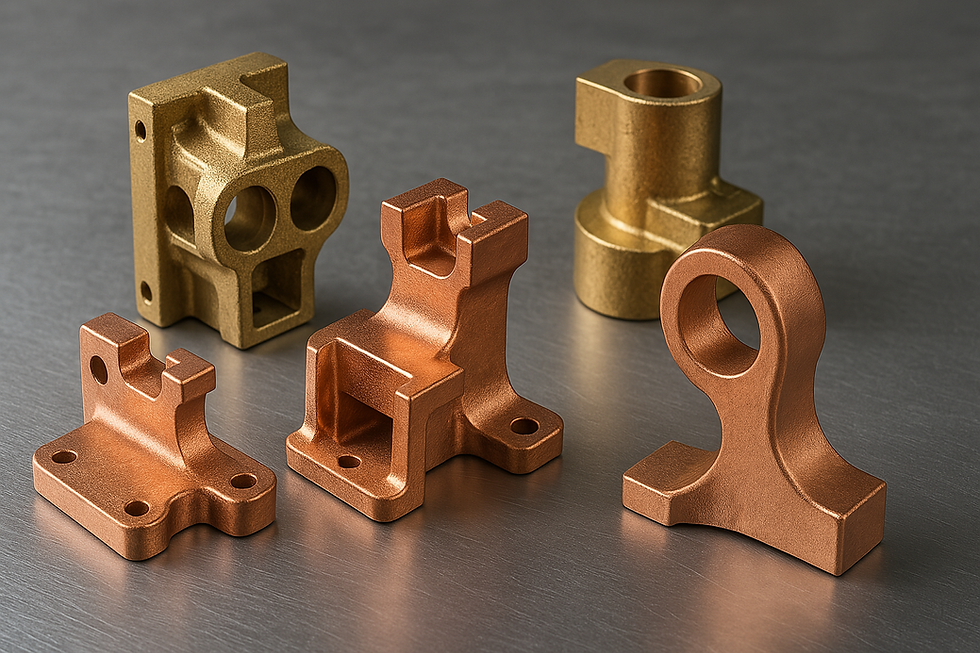
Copper alloy investment casting gives a foundry precise control over exactly this kind of variable - but only when that control is actually being applied, rather than defaulted to whatever deoxidation habit is cheapest and most porosity-proof.
The consequence isn't cosmetic. A part rated to carry a given current at an acceptable temperature rise assumes the conductivity the drawing specifies. When the actual casting delivers meaningfully less, the same current produces more resistive heating than the design accounted for - and that shows up as a hot spot, a derated capacity, or a warranty claim months after the casting passed incoming inspection with no flags raised.
What Low Conductivity Actually Costs in Service
Electrical resistance rises as conductivity falls, and resistive losses rise with the square of current - so even a conductivity shortfall that looks modest on a test report can translate into a meaningfully hotter part in service. A busbar or terminal running 10 to 15 percentage points below its specified IACS doesn't fail outright; it just runs warmer than the thermal design assumed, cycle after cycle, until insulation ages faster, a contact surface degrades, or a protection relay trips on a hot spot that was never supposed to exist.
For high-current switchgear, transformer, and power electronics components, that margin is exactly what separates a part that runs within its rated temperature class from one that quietly shortens the service life of everything bolted to it. None of this shows up as a defect on a certificate. It shows up as a support ticket, a warranty claim, or a field failure - long after the foundry that supplied the casting has moved on to the next order.
Where This Risk Shows Up Most
This failure mode concentrates wherever a copper casting is doing double duty as both a structural part and a current path - which describes most of the applications that specify pure copper investment castings in the first place.
Busbar connectors and terminal blocks in HV/MV switchgear, transformer bushing terminals, and induction heating coil components all share the same requirement: the casting has to conduct at close to the alloy's theoretical maximum, not just look like the right material. A power electronics cooling component or a semiconductor test fixture built from copper faces the same exposure, since both current-carrying capacity and heat dissipation depend directly on the same conductivity number.
None of these buyers are wrong to specify "ETP copper" on the drawing. The gap is that the alloy name describes what should be possible, not what was actually delivered - and without an explicit conductivity requirement and a test result to match, there's no way to know whether a given casting actually hits that number until it's already installed and underperforming.
Why Standard Inspection Doesn't Catch This
This failure mode is persistent because it hides in plain sight. Dimensional inspection confirms geometry. Visual inspection confirms surface finish and the absence of obvious porosity. Even a chemistry check against the alloy specification usually passes, because the deoxidizing element is present in a small enough quantity to stay within the alloy's own composition tolerance. None of these checks measure electrical conductivity directly, and IACS testing is the one requirement a buyer has to explicitly ask for rather than assume is included - which is exactly how a copper casting failed conductivity test slips past every other line on the inspection report. This is a different failure mode from the gas porosity that controlled atmosphere melting is designed to prevent, but both trace back to the same root cause: melt practice that isn't controlled and verified for what the specific application actually needs.
From a procurement standpoint, this isn't negligence - it's simply outside the scope of what a standard receiving inspection is built to check. Incoming inspection protocols are built around dimensional conformance and visual defects, because those are the failure modes that show up most often and cost the least to test for. Conductivity testing is a deliberate addition to that protocol, not a default, which means it only happens when a buyer specifically asks for it in writing.
This article is scoped to ETP copper specifically - the grade most commonly specified for busbars, terminals, and structural-electrical castings. OFHC copper is a genuinely different case: it can only be produced by vacuum melting, never air melting, and a phosphorus-based deoxidizer is effectively counterproductive in a vacuum environment built to avoid oxygen pickup in the first place, not chemically compensate for it after the fact. OFHC copper vs ETP copper: understanding the grade difference covers that distinction directly, and choosing between OFE, OFHC, and ETP grades covers the wider grade-selection decision; everything below is about getting a correctly deoxidized ETP casting.
The scale of the gap becomes clear once ETP copper is compared against the phosphorus-deoxidized grades side by side:
Grade | UNS | EN | Typical Conductivity (IACS) | Why It's Chosen |
ETP Copper | C11000 | Cu-ETP, CW004A | Typically 100-101% properly processed; Pahwa's verified minimum >92% | High conductivity, standard air-melted commercial-purity copper |
DHP Copper (high residual phosphorus) | C12200 | Cu-DHP, CW024A | ~80-85% | Weldability and porosity resistance prioritized over conductivity |
DLP Copper (low residual phosphorus) | C12000 | Cu-DLP, CW023A | ~90-95% | Intermediate - porosity control with a smaller conductivity penalty |
The 7 to 12 percentage point spread between a well-controlled ETP casting and DHP copper is exactly the range where a casting can look right, weigh right, and machine right, while still missing a conductivity-critical application's actual requirement. Phosphorus deoxidized copper conductivity is genuinely lower by design, not by defect - DHP copper is a legitimate, widely used engineering material for plumbing and general fabrication, where weldability matters more than conductivity. The sensitivity is sharper than the grade names suggest: residual phosphorus as low as 0.02 percent can pull copper's conductivity down from roughly 101 percent to 80 percent IACS or lower - a small enough addition that it barely moves a standard chemistry report, but large enough to fail a conductivity-critical part outright. Non-residual deoxidizers such as boron and lithium exist precisely to avoid this trade-off, reacting with oxygen to form a slag that lifts out of the melt rather than staying dissolved in the copper matrix - but naming a deoxidizer on a drawing doesn't help if the finished casting is never actually tested to confirm which path was taken.
For reference, the DHP copper vs OFHC conductivity gap runs even wider still, since OFHC sits close to copper's theoretical purity ceiling - but that comparison belongs to a different application entirely, not to an ETP casting's deoxidation choice. The real issue is this copper casting porosity vs conductivity trade-off being made silently, without the buyer ever being told which side of it their ETP casting landed on.
The Real Fix: Matching Deoxidation to the Application, Not Avoiding It
The instinctive fix - avoid deoxidation entirely - creates its own failure mode. Molten copper picks up oxygen readily in an uncontrolled atmosphere, and without some form of deoxidation practice, that oxygen reappears as gas porosity during solidification: internal voids that weaken the casting and can open leak paths in pressure-retaining parts. The real fix isn't choosing between deoxidizing and not - it's matching the deoxidation approach to what the specific casting's application actually needs.
Pahwa MetalTech's high-purity copper investment casting capability selects and combines deoxidation practices based on the casting's intended application and required performance parameters, rather than defaulting to one standard approach for every job, and verifies the result by testing the finished casting's actual IACS conductivity rather than assuming it from the alloy label. This is a separate failure mode from the hydrogen embrittlement risk in ETP copper forgings, but both share the same lesson: process choices made during melting and working determine a copper part's final performance far more than the alloy name on the drawing does.
In practice, verification means eddy-current conductivity testing or resistivity measurement per ASTM B193 on a sample from the actual production heat, reported as a percent IACS figure alongside the standard chemistry and dimensional report. That number is the only thing that actually confirms a casting will perform as the alloy name implies - everything else on a typical certificate confirms only that the right elements are present in roughly the right proportions, not that the finished part conducts the way the application needs it to.
What to Put on a Lost Wax Casting Purchase Order for Verified Conductivity
A complete specification for a conductivity-critical copper investment casting - also known as lost wax casting - names the grade, states the minimum acceptable IACS percentage, and requires the paperwork that proves it, rather than trusting the alloy name alone to guarantee performance. None of this requires understanding what happens inside the furnace. It requires putting a number, not just an alloy name, on the drawing, and asking for the test result that proves the foundry actually hit it.
Specification Item | What to State | Why It Matters |
Alloy designation | UNS or EN code (e.g. C11000 / Cu-ETP, CW004A) - not just "pure copper" | Removes ambiguity about which copper grade and deoxidation history applies |
Minimum conductivity requirement | An explicit minimum %IACS (e.g. 92% IACS minimum) | Turns an assumption into a measurable, enforceable acceptance criterion |
Conductivity test method | Eddy-current testing, or resistivity testing per ASTM B193, reported on the certificate | Confirms the requirement was actually verified, not just assumed from alloy chemistry |
Material certificate | EN 10204 Type 3.1 with the measured conductivity value from the production heat | Real test data from the actual batch, not a generic conformance statement |
Every item on this list is something a buyer can verify from a document, without needing to understand deoxidation chemistry at all. The point isn't to become a melting expert - it's to stop treating "pure copper" as a self-verifying claim and start treating conductivity as a number that has to be tested and proven, the same way a dimensional tolerance already is.
3 Signs Your Copper Casting Has This Problem
The material certificate shows chemistry and composition but no measured conductivity value anywhere on it.
Parts from different heats or batches of the "same" alloy perform inconsistently in service, despite all of them passing incoming dimensional inspection.
The foundry can't explain, when asked directly, what deoxidation approach was used on this specific casting or why it fits the application.
Get Copper Investment Castings With Verified Conductivity, Not Just a Certificate
Pahwa MetalTech casts ETP copper investment castings, part of a wider copper alloy investment casting range - also known as lost wax castings - with the deoxidation approach matched to your application and conductivity verified to better than 92% IACS, not assumed from the alloy chemistry alone. OFHC copper, where an application genuinely calls for it, is available separately through vacuum melting.
Share your drawing and required conductivity specification through our contact page, and we'll confirm feasibility along with the exact verification protocol we'll test against before the first casting ships.


Comments